We accept payment in Indian Rupees(INR) through UPI/Credit Cards/Local Bank Transfer and in US Dollar through Remitly


About GMAT
Understand the exam, its structure, and how scoring works
What is the GMAT?
The GMAT (Graduate Management Admission Test) is a standardised test that business schools use to evaluate applicants for admission to graduate management degree programs. Admissions committees at business schools assess a candidate’s readiness for a management program based on their GMAT score.
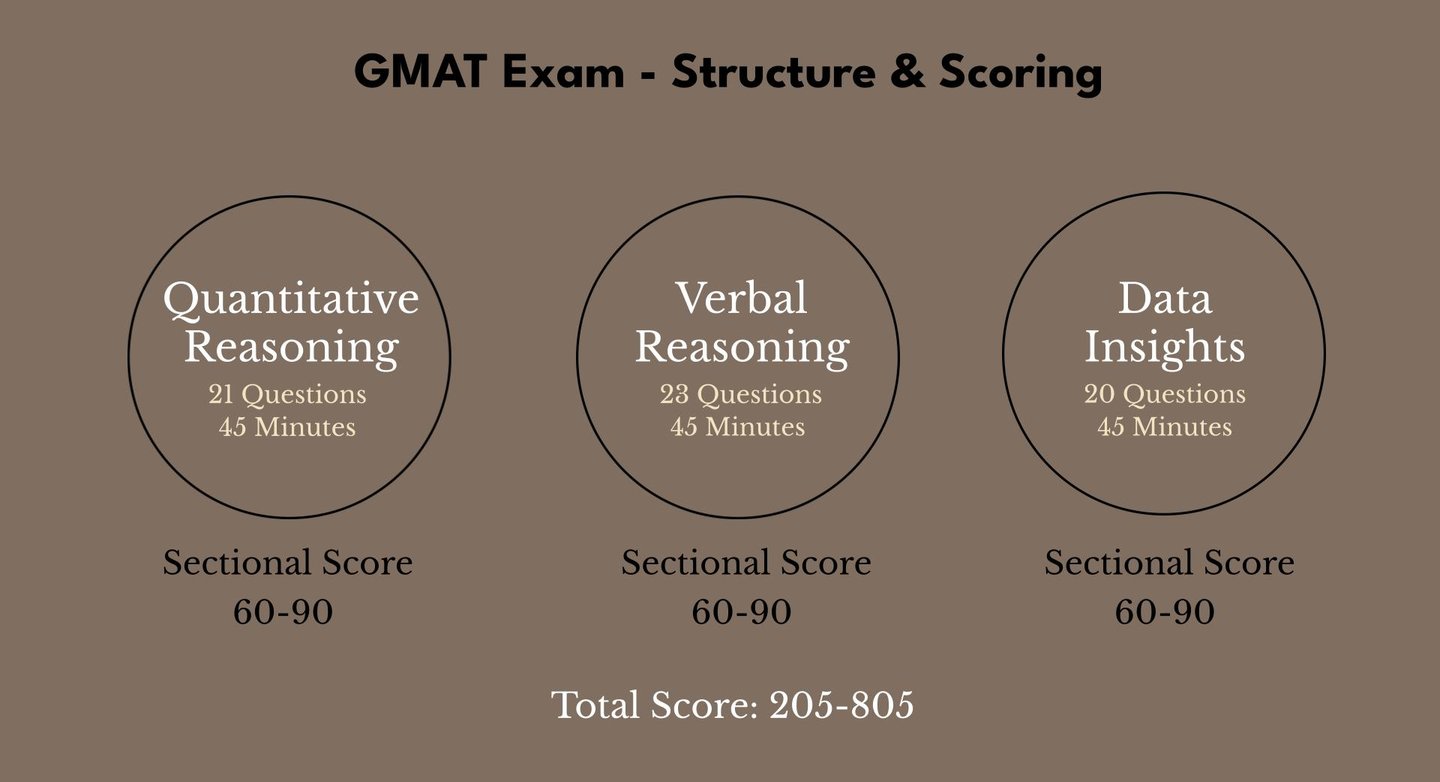
GMAT Exam Content
Quantitative Reasoning
This section evaluates your foundational knowledge in algebra and arithmetic, as well as your ability to use this knowledge to solve problems. It consists of 21 Problem Solving questions.
These question types necessitate some understanding of arithmetic and basic algebra. Correctly answering these questions depends on logic and analytical abilities rather than just math skills. You are not allowed to use a calculator while completing this section.
Verbal Reasoning
This section assesses your capability to read and comprehend written content while reasoning and evaluating arguments. It consists of 23 Reading Comprehension and Critical Reasoning questions.
Reading Comprehension questions evaluate your ability to grasp words and statements, recognize logical relationships between key points, draw conclusions, and track the development of quantitative ideas. Specifically, the following reading skills will be assessed: main idea, supporting idea, inference, application, logical structure, and style.
Critical Reasoning questions test your capacity to construct arguments, analyze them, and formulate or assess a course of action. These questions are based on a brief reading passage, usually less than 100 words. Typically, the short text is accompanied by a question that asks which of the five answer choices strengthens or weakens an argument, explains why the argument is flawed, or significantly supports or undermines the argument. Specialized knowledge of the subject matter is not essential to respond to the questions.
Data Insights
The Data Insights section evaluates candidates' skills in analyzing and interpreting data as well as applying these skills to practical business situations. It also assesses digital and data literacy, which are among the most sought-after skills in today's business environment.
This section consists of 20 questions that require you to evaluate how various sources and types of information—including graphical, numerical, and verbal—connect with one another and can be utilized for making informed choices. Questions may involve mathematics, data analysis, verbal reasoning, or a combination of all three. An on-screen calculator can be used during this section.
The types of questions you’ll encounter in this section include:
Data Sufficiency: Assesses your ability to analyze a quantitative issue, identify pertinent data, and determine when there is sufficient information to resolve the problem.
Multi-Source Reasoning: Evaluates your ability to analyze data from multiple origins, including text passages, tables, graphics, or a combination of these—examining each data source critically to answer several questions. Some questions will require you to spot inconsistencies among various data sources, while others will ask you to draw conclusions or discern the relevance of data.
Table Analysis: Tests your ability to organize and analyze a data table, akin to a spreadsheet, to determine what information is important or meets specific conditions.
Graphics Interpretation: Measures your capability to interpret information shown in a graph or other visual representations (scatter plots, x/y graphs, bar charts, pie charts, or statistical distributions) to identify relationships and draw conclusions.
Two-Part Analysis: Evaluates your proficiency in solving complex problems which can be quantitative, verbal, or a mixture of both. The format is deliberately versatile to encompass a broad spectrum of content. Your skills in assessing trade-offs, solving simultaneous equations, and understanding relationships between two entities are evaluated.
PREPSET
Expert online sessions for GMAT and GRE prep.
CONTACT US
Subscribe for email services
© 2025. All rights reserved.
We are not affiliated with or endorsed by Educational Testing Services (ETS) or Graduate Management Admission Council (GMAC). GRE and GMAT are registered trademarks of ETS and GMAC respectively and are used here solely for purposes of identification.